Treated seed is coloured because a federal rule says so, and buyers routinely read that rule wider than it goes. 40 CFR 153.155(a) sets a condition on any pesticide product sold for seed treatment: it must carry an EPA-approved dye.[3] The dye is not a pigment, the colour is not specified, and not every product is covered. This page reads the text clause by clause.
What Does the Rule Actually Require?
Key Takeaways
- The duty sits on the pesticide product, not on the plant that coats the seed.
- An EPA-approved dye is defined by where it appears in Part 180 — and mica and iron oxide appear there under a different heading.
- The colour must be unnatural, and no colour is named. That gap is what lets a brand code varieties by shade at all.
- We supply effect pigments as colorants. Whether a grade fits a registration is the registrant's determination, not ours.
The requirement is a single sentence. A pesticide product intended for use in treating seed must contain an EPA-approved dye to impart an unnatural color to the seed.[3] Two words do the work: dye and unnatural. Everything the section aims at runs through them, and so does nearly every misreading of it.
Note where the obligation sits. It is a condition on the product — on what the formulation must contain — not a duty on the plant that applies it to seed. A treater either buys a product that already carries the dye, or buys an exempt product and meters dye into the tank. That fork decides whose price you are comparing when you cost a colour for a seed lot.
The sentence then closes with an exception: unless appropriate tolerances or other clearances have been established under the Federal Food, Drug and Cosmetic Act for residues of the pesticide.[3] The colour requirement is tied to residues in food and feed. Appearance is not the interest the clause protects.
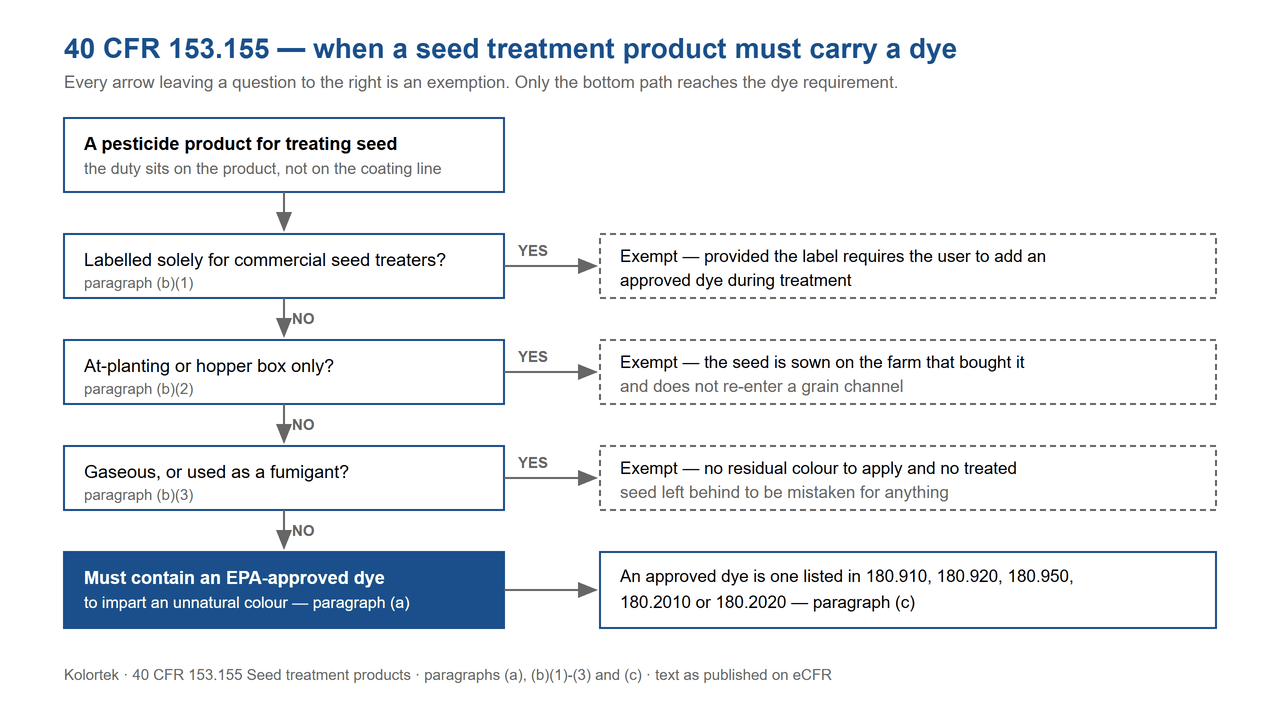
Figure 1. The three exemptions in paragraph (b) all remove the same risk — seed that could be diverted into food or feed. Only a product that clears all three reaches the dye requirement in paragraph (a).
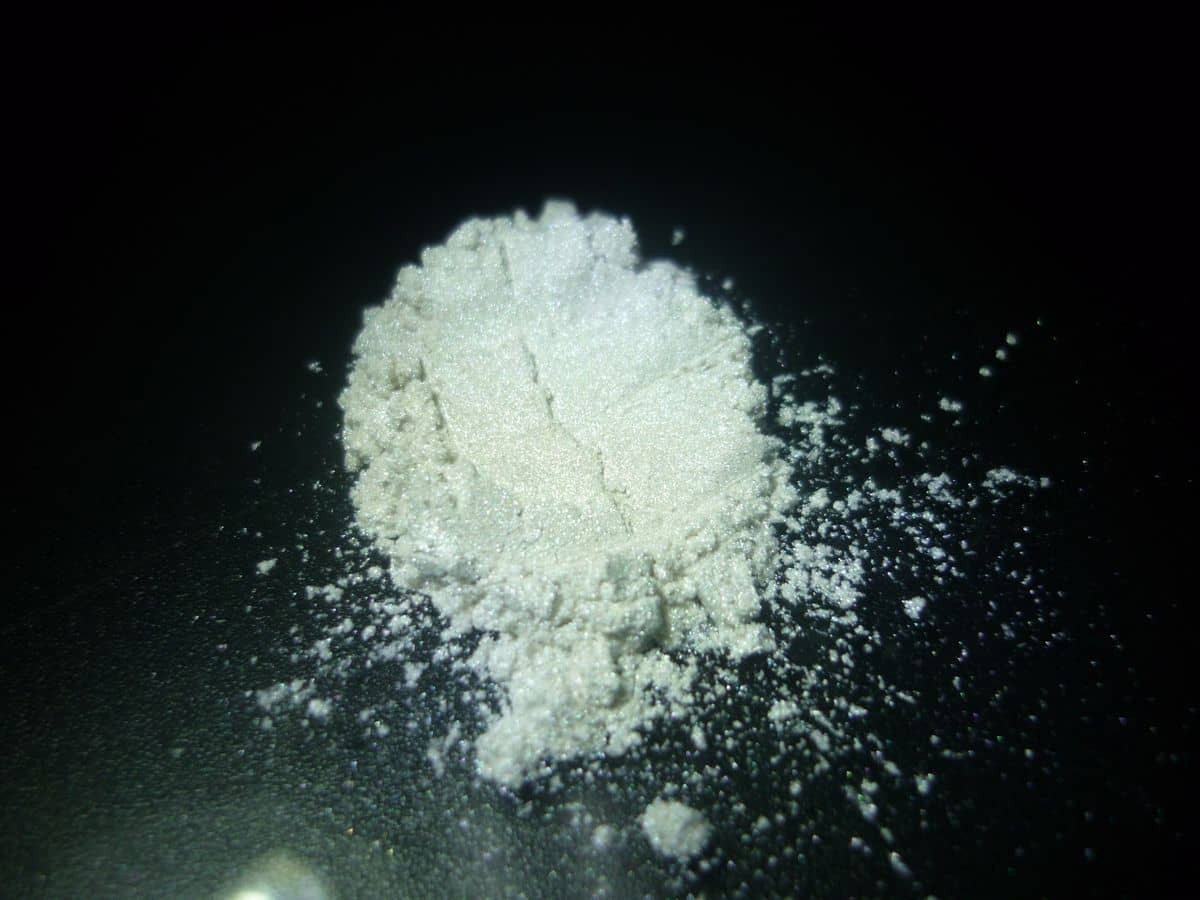
Figure 2. An effect pigment as supplied. Whatever the film around a seed is asked to prove, the material inside it starts as a powder like this.
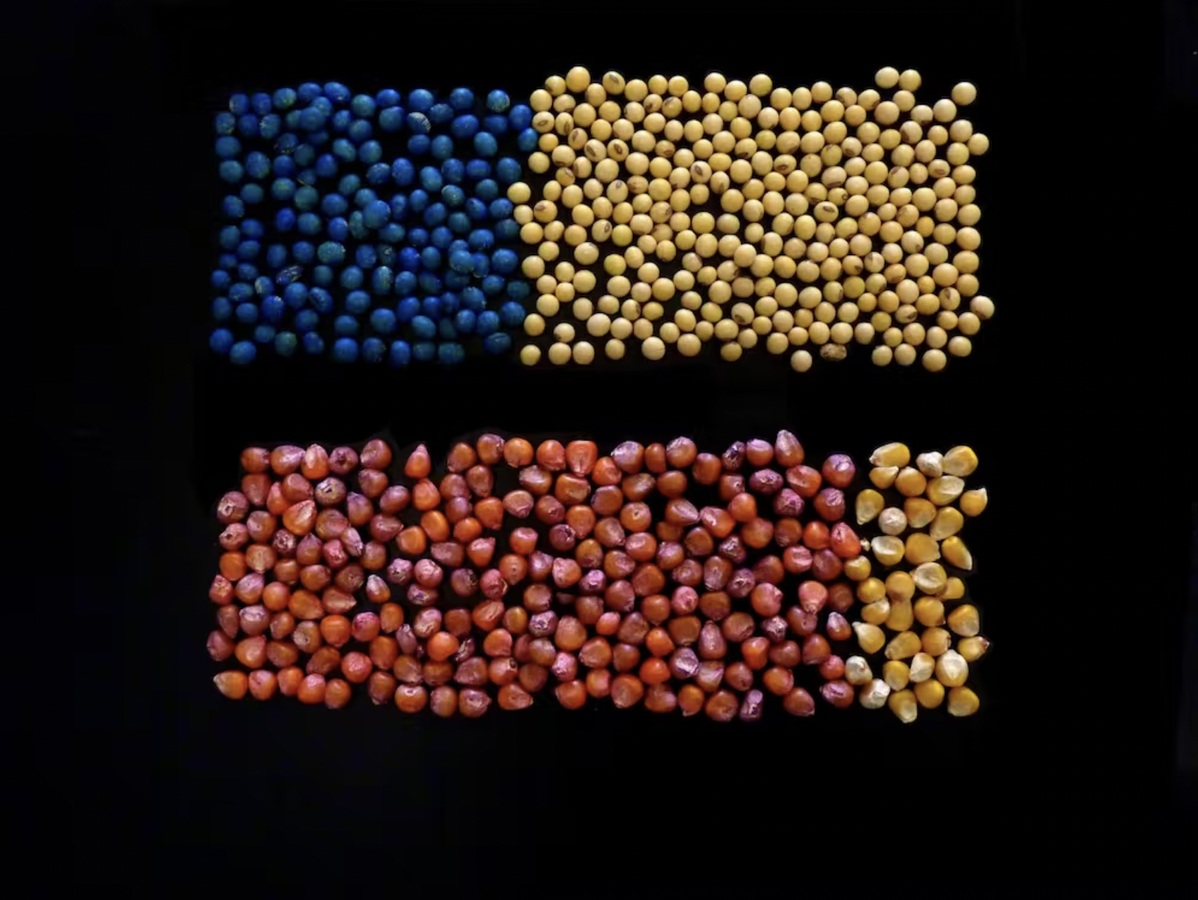
Figure 3. Treated soybean (blue) and maize (red) seed beside untreated seed of the same crop. The colour is a marker, not the active ingredient — it is there so a bag can be identified at a glance. Photograph: Ian Grettenberger, Penn State University, via Science Learning Hub, CC BY-ND 4.0.
Why Must the Colour Be Unnatural?
A treated seed still looks like a seed. It sits in bags, climbs an auger, waits in a hopper next to grain that is going to a mill. An unnatural colour is one that cannot be taken for that grain at arm's length. Paragraph (a) never states the reason out loud. The residue clause points at it, and the three exemptions in paragraph (b) confirm the reading.
- Products labelled for use solely by commercial seed treaters are exempt, on condition that the label instructs the user to add an EPA-approved dye during treatment. The obligation moves down the chain rather than vanishing; the treater's tank becomes the point where colour enters.
- Products for at-planting or hopper-box treatment are exempt. Seed treated that way goes into the ground on the farm that bought it and never enters a grain channel.
- Gaseous products and fumigants are exempt. Nothing solid is left carrying a colour, and no treated seed remains behind to be mistaken for anything else.
Where Does an Effect Pigment Sit in That System?
Paragraph (c) settles the next question — which dyes count — by pointing into Part 180: sections 180.910, 180.920 and 180.950, where a tolerance exemption exists; section 180.2010, where residues fall below the threshold of regulation; and section 180.2020, where no tolerance is required.[3] An approved dye is, by definition, something listed in one of those places.
Here the argument breaks in both directions. Mica is listed in section 180.910. Iron oxide is listed in section 180.910. Read that far and the listing looks claimable. But the entry reads solid diluent, carrier — an inert-ingredient function, not a dye.[4] Titanium dioxide is not in section 180.910 at all. A pearlescent pigment — a mica or glass platelet coated with titanium dioxide, and on some grades with iron oxide — therefore cannot be described as an EPA-approved dye. It is just as wrong to say it appears nowhere in that section. Both shortcuts are false, and the buyer who opens the eCFR will see which one you took.
| Component |
Where it is listed |
What the listing establishes |
| An approved dye |
180.910 / .920 / .950 / .2010 / .2020, per 153.155(c) |
Meets the colour requirement of 153.155(a) |
| Mica, iron oxide |
180.910 |
Inert ingredient — solid diluent, carrier |
| Titanium dioxide |
Not in 180.910 |
Nothing follows from this page about where else it sits |
| Effect pigment |
Supplied as a colorant |
Regulatory standing is decided by the registrant |
What an effect pigment contributes is optical. Its colour comes from interference inside the oxide layer, not from absorption by a dissolved molecule,[1] and because the particle is a flat platelet, the shade you read out of the film depends on how those platelets lie in it.[2] That is a different behaviour, not a better one. It is also why an effect layer carries something a dye cannot: the shade moves with viewing angle, and stirring a soluble colourant into the tank will not reproduce it.
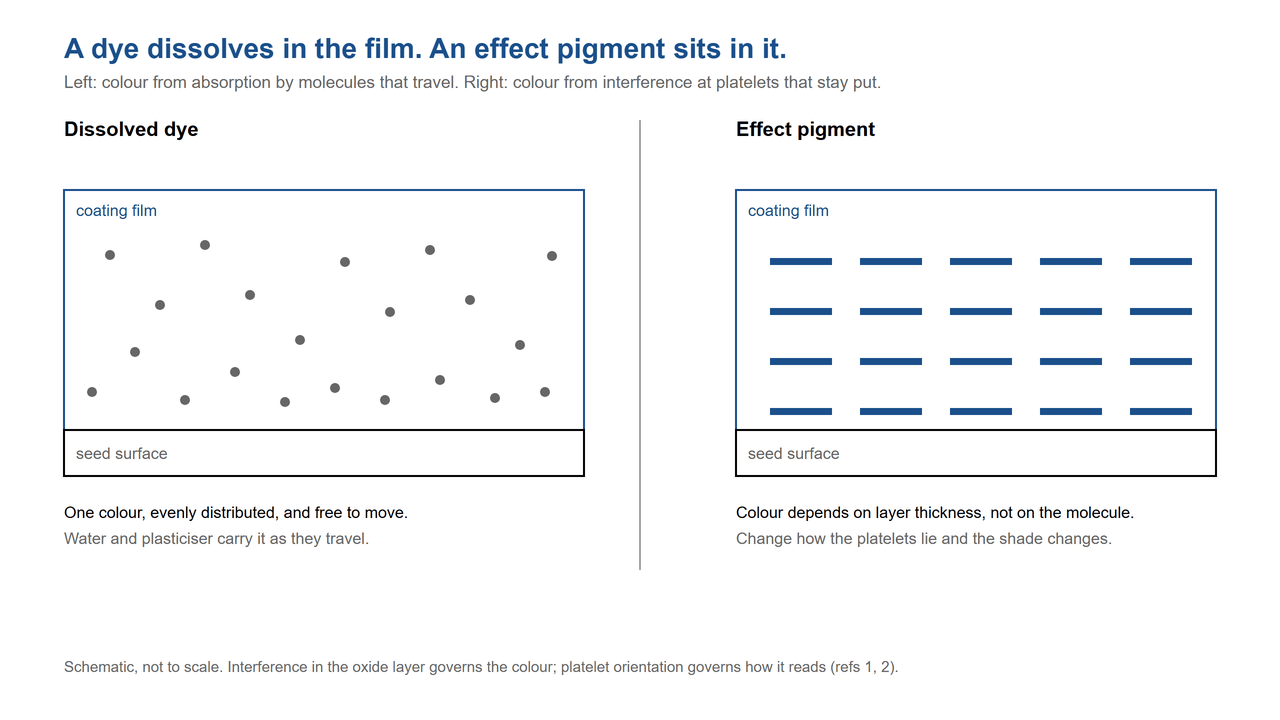
Figure 4. A dissolved dye and a platelet pigment occupy the same film in different ways. The dye travels with whatever moves through the film; the platelet stays where the film was dried around it.
What Does the Rule Leave Open?
Almost everything about the colour itself. The text demands an unnatural colour and then names none of them. Red became the convention because it is the least ambiguous, not because a paragraph says so. That silence is what makes colour coding possible: force every treated lot to one colour and separating varieties, treatment classes and brands by shade is off the table.
The same silence puts the load on the film. A treated-seed colour has to survive handling, not merely read distinctly in the treater's tank. Bag friction, augers and the road to the field all work on the coating. A colour that is right on the day of treatment and gone by planting has not done what the rule is after.
The physical constraint that follows belongs to the coating, not the regulation: the flake has to sit inside the film instead of standing out of it. That is particle size measured against film thickness. It decides most of the practical choices on this application, and we set it out separately on our pearlescent pigments page.
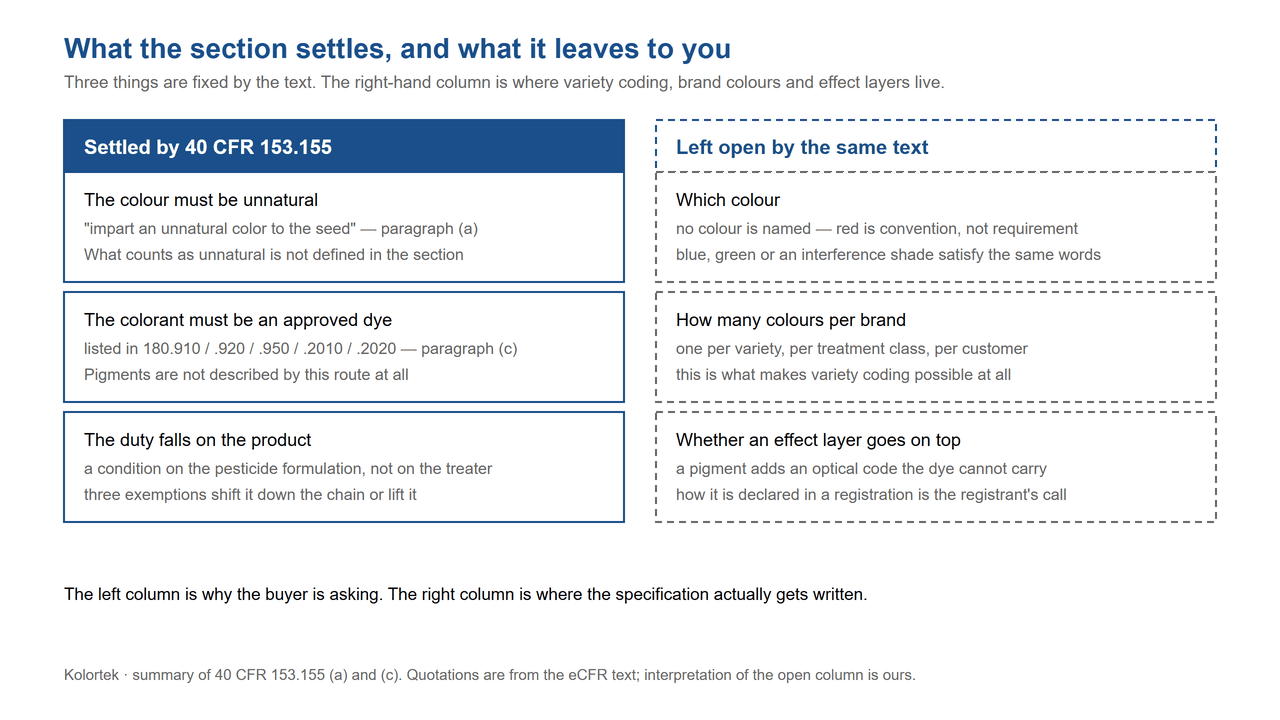
Figure 5. The section fixes what the colour must be and where it must come from. It says nothing about which colour, how many a brand may run, or whether an effect layer is added on top.
Frequently Asked Questions
Is an effect pigment an EPA-approved dye?
No. The rule asks for a dye, and the dyes it recognises are those listed in sections 180.910, 180.920, 180.950, 180.2010 and 180.2020.[3] We supply effect pigments as colorants. Where mica and iron oxide do appear in section 180.910, the entry covers inert-ingredient use as a diluent or carrier — a different listing from a dye.[4] How a grade is declared in a registration file is the registrant's call.
Does the rule require treated seed to be red?
No. The wording is an unnatural color, and no colour name appears anywhere in the section.[3] Red is an industry convention built on being hard to misread. A blue, a green or an interference shade meets the same words.
Can one coating carry both a dye and an effect pigment?
In principle yes, and the two would be doing separate jobs: the dye carries the regulatory signal, the effect pigment carries the brand or variety code beside it. Whether a given combination can be registered is a formulation and labelling question that belongs to the registrant. A pigment supplier cannot settle it for you.
Does an even colour prove the treatment went on evenly?
It should not be read that way. Colour is a visual check, and a useful one, but the spread of a colorant across a lot does not automatically track the spread of every active in a multi-component slurry. Where proof of application uniformity is needed, it comes from sampling and analysis, not from a colour reading.
Talk to Our Application Team
We supply effect pigments as colorants, in fine and standard platelet sizes, and we will tell you plainly which parts of a registration question our documentation answers and which parts belong to you and your registrant. The pearl pigment colour cards put the shades and the platelet sizes in one file. Our quality management system is certified to ISO 9001:2015, and certificates covering REACH, RoHS, Halal, Kosher and US FDA registration are provided on request for the grade and the market you are working to.
Send us the coating film thickness you are running, the colour coding you need across your varieties, and the market you are registering in. We will build a sample pack around that application, with the technical data the grade actually carries.
References
- Maile, F. J.; Pfaff, G.; Reynders, P. Effect pigments—past, present and future. Progress in Organic Coatings 2005, 54 (3), 150–163. https://doi.org/10.1016/j.porgcoat.2005.07.003
- Kettler, W. H.; Richter, G. Investigation on topology of platelet-like effect-pigments in automotive surface-coatings. Progress in Organic Coatings 1997, 31 (4), 297–306. https://doi.org/10.1016/S0300-9440(97)00087-8
- United States. 40 CFR 153.155 — Seed treatment products. Electronic Code of Federal Regulations, Title 40, Part 153, Subpart H. https://www.ecfr.gov/current/title-40/chapter-I/subchapter-E/part-153/subpart-H/section-153.155
- United States. 40 CFR 180.910 — Inert ingredients used pre- and post-harvest; exemptions from the requirement of a tolerance. Electronic Code of Federal Regulations, Title 40, Part 180, Subpart D. https://www.ecfr.gov/current/title-40/chapter-I/subchapter-E/part-180/subpart-D/section-180.910

 Deutsch
 English
 Français
 Русский
 Español
 Português